


ANSI Roller Chain

Wolff Chain Drive: Your Professional ANSI Roller Chain Manufacturer!
Qingdao Wolff Chain Drive Co.Ltd. is located in the industrial zone of the city, covering an area of about 10,000 square meters. Our factory has multiple workshops, which are used for different production links and product manufacturing. We continue to innovate, develop new products, meet all customer requirements, and have stable delivery times.
Our Advantages
Rich Experience & Production Market
Our company has a production history of more than 30 years, and our products have won unanimous praise from customers. Wolff chains are popular in Domestic and foreign markets such as the United States, South America, Europe, the Middle East, Southeast Asia and Africa markets.
Quality Control
Our products are produced and inspected strictly in accordance with GB, AISI, ASTM, API, JIS, BS so as to control and safeguard the quality of products. We adopt strict testing standards and processes to ensure that our products meet international standards and customer requirements. We have a professional quality inspection team to conduct comprehensive inspection and testing of each production batch.
Advanced Equipment
Our factory is equipped with advanced production equipment and technology, including automated production lines, CNC machine tools, laser cutting machines, etc. These equipment can efficiently complete the manufacturing and processing of products and improve production efficiency.
High Quality Product
All our products fully comply with international standards such as ISO\DIN\ANSI\BS\JIS. Wolff has successfully passed ISO9001 quality management system, SGS inspection and BV inspection certification.
-
![Simplex Roller Chain]() Simplex Roller ChainSimplex roller chain is a chain form consisting of a series of rollers and link plates. Roller chains are often used to transmit power or carry heavy loads. The rollers on the chain mesh with the...read more
Simplex Roller ChainSimplex roller chain is a chain form consisting of a series of rollers and link plates. Roller chains are often used to transmit power or carry heavy loads. The rollers on the chain mesh with the...read more -
![Duplex Roller Chain]() Duplex Roller ChainThe duplex roller chain offers a combination of high strength, high fatigue resistance, and long lifespan, making it a reliable and durable option for a variety of applications.read more
Duplex Roller ChainThe duplex roller chain offers a combination of high strength, high fatigue resistance, and long lifespan, making it a reliable and durable option for a variety of applications.read more -
![Triplex Roller Chain]() Triplex Roller ChainA triplex roller chain is a type of roller chain that consists of three rows of chain links in parallel. Each link has small rollers that rotate freely and engage with the teeth of a sprocket,...read more
Triplex Roller ChainA triplex roller chain is a type of roller chain that consists of three rows of chain links in parallel. Each link has small rollers that rotate freely and engage with the teeth of a sprocket,...read more -
![Leaf Chains]() Leaf ChainsLeaf chains are a type of transmission chain drive that consists of interlocking metal plates resembling the shape of a leaf. These chains are commonly used in various industrial applications,...read more
Leaf ChainsLeaf chains are a type of transmission chain drive that consists of interlocking metal plates resembling the shape of a leaf. These chains are commonly used in various industrial applications,...read more -
![AL Series Leaf Chain]() AL Series Leaf ChainThe AL Series Leaf Chain is a type of roller chain designed for heavy-duty lifting and conveying applications. Made from high-quality alloy steel, the AL Series Leaf Chain is known for its...read more
AL Series Leaf ChainThe AL Series Leaf Chain is a type of roller chain designed for heavy-duty lifting and conveying applications. Made from high-quality alloy steel, the AL Series Leaf Chain is known for its...read more -
![BL Series Leaf Chain]() BL Series Leaf ChainBL Series Leaf Chain is a type of roller chain that is commonly used in material handling applications. It is designed to handle heavy loads and provide reliable performance in demanding environments.read more
BL Series Leaf ChainBL Series Leaf Chain is a type of roller chain that is commonly used in material handling applications. It is designed to handle heavy loads and provide reliable performance in demanding environments.read more -
![Single Strand Roller Chains]() Single Strand Roller ChainsSingle strand roller chains, also known as simplex roller chains, are widely used in various industrial applications for transmitting mechanical power efficiently. They consist of a series of...read more
Single Strand Roller ChainsSingle strand roller chains, also known as simplex roller chains, are widely used in various industrial applications for transmitting mechanical power efficiently. They consist of a series of...read more


Introduction to ANSI Roller Chain
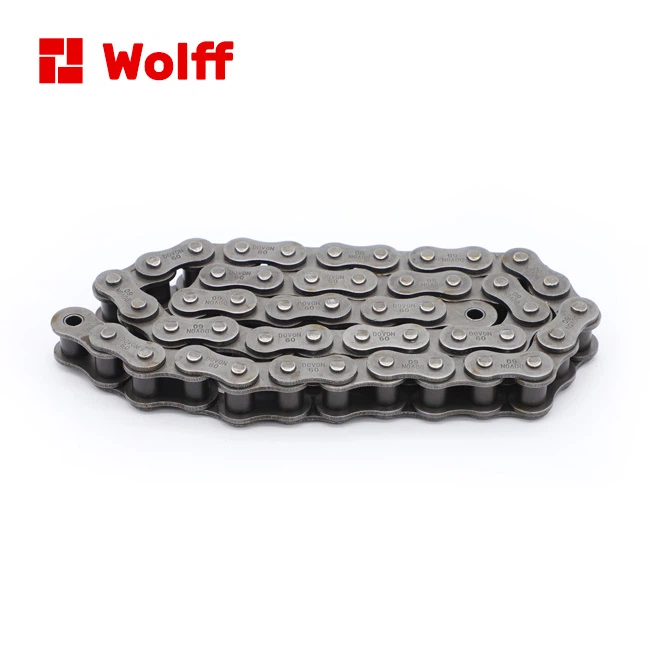
ANSI roller chain refers to the roller chains that meet ANSI standard. ANSI or American National Standards Institute Roller chains are used for the transmission of mechanical power on industrial and agricultural machinery such as Conveyor systems. These are available in: Simplex, Duplex and Triplex.
Components of ANSI Roller Chain
Link Plates
Link plates serve as the foundation of a roller chain. These flat metal plates connect various chain links together, forming a continuous loop structure. The robustness and integrity of link plates are crucial to the overall strength and performance of the chain.
Rollers
Integral to the functionality of a roller chain, rollers are cylindrical components that reside between the link plates. These rollers ensure smooth rotation and reduce friction during operation, enhancing the efficiency and lifespan of the chain.
Bushings
Bushings are cylindrical metal sleeves that accommodate the pins within the roller chain. By providing a low-friction surface for the pin rotation, bushings contribute to the overall strength and longevity of the chain.
Pins
Pins act as the primary connecting elements within a roller chain. They fit through the bushings and link plates, securing the chain's structure and allowing it to transmit power effectively. The pins play a vital role in maintaining the integrity and functionality of the chain.
Types of ANSI Roller Chain

Standard Roller Chains
These chains are the most commonly used type of roller chain and are used in various mechanical applications, including automobiles, motorcycles, and industrial machinery.

Heavy-Duty Roller Chains
These chains are designed for heavy-duty applications that require high strength and durability. They are used in construction equipment, mining machinery, and other industrial applications.

Double-Pitch Roller Chains
These chains have twice the pitch of standard roller chains and are used in applications that require longer chain lengths and slower operating speeds.

Silent Chains
These chains are designed to operate with minimal noise and vibration and are used in high-speed applications such as printing presses and conveyor systems.
Advantages of ANSI Roller Chain
High Efficiency
ANSI roller chains are designed with minimal friction, resulting in high power transmission efficiency. This efficiency is crucial in applications where energy conservation is essential, as it reduces power losses and improves overall system performance.
Robust and Durable
ANSI roller chains are built to withstand heavy loads and harsh operating conditions. The construction typically involves durable materials, such as high-grade alloy steel, which provides excellent resistance to wear, fatigue, and corrosion. As a result, roller chains have a long operational life, reducing maintenance requirements and downtime.
Cost-Effective
Compared to some alternative power transmission methods, ANSI roller chains are relatively cost-effective. Their straightforward design and manufacturing process make them an affordable option for a wide range of applications, making them ideal for both small-scale and large-scale projects.
Wide Range of Sizes and Configurations
ANSI roller chains are available in various sizes and configurations to suit different power transmission needs. This adaptability allows engineers and designers to select the appropriate chain size and pitch for specific applications, ensuring optimal performance and safety.
Simple Installation and Maintenance
Installing and maintaining ANSI roller chains is relatively straight forward. Once properly installed and adequately lubricated, they require minimal attention during operation. Routine maintenance involves periodic lubrication and inspection for signs of wear, making them convenient for operators and maintenance personnel.
Shock Absorption
ANSI roller chains have a certain amount of flexibility, which enables them to absorb shocks and vibrations during operation. This feature is particularly useful in applications where sudden load changes or uneven forces may occur.
Versatility
ANSI roller chains can be used in a wide variety of applications, including conveyor systems, industrial machinery, agricultural equipment, motorcycles, and bicycles, among others. Their versatility stems from their ability to handle different load capacities and accommodate diverse environments.
Compact Design
ANSI roller chains have a compact and lightweight design, making them suitable for applications with limited space constraints. Their small footprint allows for efficient integration into various machines and systems.
High Speed Capability
ANSI roller chains can handle high rotational speeds effectively, making them suitable for applications requiring fast and precise motion transmission.
Global Availability
Due to their widespread use and popularity, ANSI roller chains and their components are readily available worldwide. This accessibility simplifies sourcing, replacement, and maintenance, regardless of the location of the equipment.
Installation Of ANSI Roller Chain

Speed Ratio and Chain Lap
The speed ratio of ANSI Roller Chain can range up to 7:1 under normal conditions.
However, a speed ratio of 10:1 is possible if the required speed is very slow.
Chain lap on the small sprocket must be at least 120 degrees.

Distance Between Shafts
Optimum distance between sprockets is 30 to 50 times the pitch of the chain, except when there is a pulsating load. In such cases, the distance can be up to 20 times the pitch of the chain.
Layout
When arranging the roller chain drive, the centerline of both sprockets should be as close to horizontal as possible, though the angle of installation can be up to 60 degrees. If installation is close to vertical, slight chain elongation can cause the chain to easily slip off the sprockets. In this case, an idler or guide stopper is recommended.
It is best to keep the angle of installation within 60 degrees. If the angle must be more than 60 degrees.

Roller Chain Tension
Initial tension for roller chain power transmission is not as critical as for belt transmission. Generally, roller chain is used with adequate slack. Slack on the lower side is most desirable.
If the chain is excessively tight, chain damage or rapid use of lubricant may result.
If the chain is too loose, damage due to vibration or chain winding may result.
Checkpoints of ANSI Roller Chain
Lubrication
While the chain is in operation, check that the lubricating oil moves toward the link plates and that the chain or rotating disc is immersed in the oil bath. When the chain is stopped, check for dirt or abrasive particles produced by improper lubrication. When the chain is removed, the connecting link pin and the inside edge of the bushing should be checked. Damage or a red or reddish-brown color signal improper or insufficient lubrication.
Link Plate
Chain exposed to repeated loads over the allowable load can develop fatigue breaks in the link plate. Fatigue breaks are difficult to anticipate until they produce a crack.
Cracks usually develop at the edge of a hole or at the side of the link plate. Check link plates often for cracks to prevent accidents.
Roller Link
Care should be taken to avoid repeated impact loads over the allowable load as fatigue breaks may occur. The roller should be checked in the same way as the link plate. If foreign objects interfere with the engagement of the roller and sprocket, the roller may be damaged and a crack may develop. Chains damaged by fatigue breaks must be replaced.
Sprocket
Chain and sprocket engagement can be checked by observing the roller and sprocket tooth surfaces. Installation should also be checked. Normal margin position is slightly above the tooth bottom. If tension remains on the slack side, the roller will touch the tooth bottom slightly. If an idler or tightener is used, the margin will be at the center of the tooth bottom.
Chain Elongation
Chain stretch is calculated as the total amount of elongation caused by wear on the pin and bushing, not including deformation of the link plate. Measuring chain elongation can help estimate the remaining life of the chain.
FAQ
As one of the leading ansi roller chain manufacturers and suppliers in China, we warmly welcome you to wholesale cheap ansi roller chain from our factory. All customized products are with high quality and low price. Contact us for quotation.
roller chain conveyor, outdoor roller chain, power transmission system with roller chain